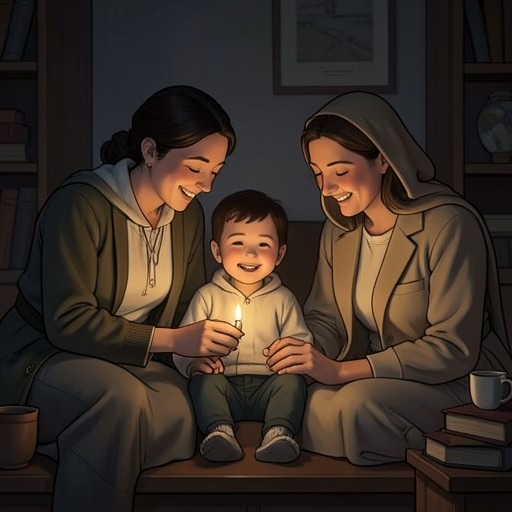
Kate
The GiftKate is the daughter Maribeth Robertson gives birth to and the child Liz and John Whittaker adopt. Her arrival transforms a plan initially imagined as a conventional adoption into a deeply personal arrangement between two families: Maribeth chooses the Whittakers, the people who have supported her, and they welcome her baby into the home still marked by Annie’s death. Kate’s beginning is therefore both a birth and a parting, bringing renewed hope to the Whittakers while requiring Maribeth to relinquish the role of her mother.
Identity and Background
Kate is conceived before Maribeth, sixteen and separated from her family, comes to know Tommy Whittaker. When the two discover that they are the same age, their circumstances sharply contrast: Tommy still has a family and a home, while Maribeth has left hers and expects to give birth to a child whose father has not loved her. That difference frames the conditions into which Kate is born. Maribeth has been working and continuing her education with Tommy’s help, but she does not believe she can raise the baby herself or return to the Whittakers with the child.
The prospect of adoption is not abstract for Maribeth. At the Sisters of Charity convent, she sees another young mother’s newborn taken away to waiting adoptive parents without the mother ever seeing the baby. The experience makes the arrangement seem secretive and harsh. Later, the baby gifts given to Maribeth by her coworkers make her own child newly tangible: the clothes, blanket, toys, diapers, and high chair represent a real infant with a future, not merely the consequence of a difficult pregnancy. Facing the fact that she cannot keep the baby, she asks Dr. Avery MacLean to find adoptive parents.
Birth and Adoption
Maribeth’s decision changes when she asks Liz to adopt the baby herself. Liz is astonished by the request, and Maribeth clarifies that she wants both Liz and John to become the child’s parents. The choice grows out of the closeness between the women and Maribeth’s trust in the Whittakers; it also gives the baby a place in a family Maribeth knows and believes will love her. For Liz and John, the adoption brings a child into their lives after the death of Annie, their daughter.
Kate is born after midnight following a difficult labor. Her position complicates delivery, and forceps are used. Liz stays beside Maribeth, who has asked her to promise that she will take the baby and love her. Liz promises, and after the birth Maribeth identifies the baby as Liz’s little girl, even as the doctor reminds her that she is Maribeth’s daughter. That exchange holds the central distinction of Kate’s early life: she is Maribeth’s child by birth and is to become Liz and John’s child through adoption.
The baby is a girl with strawberry-blond hair. When Liz holds her, the narration presents the moment as the beginning of a new family bond; Tommy, looking at his parents and the infant, thinks Annie would have loved her. At three in the morning, the family stops at the nursery window to look at the sleeping child. The scene connects Kate’s arrival to the family’s memory of Annie, but it does not make Kate a replacement for her. Rather, the baby’s presence allows the Whittakers to imagine a future again while keeping their lost daughter in their thoughts.
Family, Loss, and Belonging
The Whittakers prepare for Kate by bringing out Annie’s old bassinet, repainting it, and decorating it with pink gauze and ribbons. The reuse of the bassinet makes the family’s past physically present in the preparations for a new child. At the same time, Tommy visits Annie’s grave and thinks about both the Christmas tree he and Maribeth brought there and the baby. His feelings are mixed: he is happy about what is happening but fears Maribeth will leave. Kate’s arrival thus comes amid grief rather than after it has simply ended.
The infant also changes the Whittakers’ relationships with one another. Liz is happier than Tommy has seen her in a year, and the family’s attention to the baby gives them a shared purpose. John and Tommy ready the bassinet, while Liz cares for Kate and stays up with her. Liz and John’s closeness is renewed as they watch Liz hold the child and speak of the lost sleep ahead. Kate brings the possibility of tenderness and family life back into a household where Annie’s absence had left the parents estranged and Tommy withdrawn.
Kate’s place with the Whittakers is made concrete in the family’s ordinary care. On the day Maribeth leaves the hospital, Liz carries the baby to the car, John takes photographs, and the family spends the afternoon at home. When Kate cries, Liz goes to her. Maribeth tries not to respond, understanding that she must create distance if she is to let the adoption proceed. The passage is not a simple transfer of affection: the baby’s presence makes the separation more immediate precisely because she is now someone Maribeth can imagine caring for.
Adoption and the Hidden Origins
Three days after Kate’s birth, Maribeth signs the adoption papers. The lawyer explains the documents, and she waives the waiting period, signing with a shaking hand. She hugs Liz afterward, and she and the nurse ask that the baby not be brought to her that day. Maribeth needs time to mourn. Her consent is firm, but it does not erase the cost: she believes giving Kate up is the right decision for the baby while still experiencing the loss as a bereavement.
The family agrees that Kate will be told, for the time being, that Maribeth is their friend rather than her birth mother. They leave open the possibility that they may tell Kate the truth when she is grown, if she needs to know, but no immediate disclosure is planned. The arrangement gives Kate a settled identity as Liz and John’s daughter while withholding the history of her birth and the relationship that connects her to Maribeth. Maribeth, meanwhile, recognizes that she may remain in Kate’s life only as a friend if their lives continue to be entwined. The difference between biological and adoptive motherhood is thus not merely legal: it shapes what each woman may tell Kate and what role Maribeth can occupy.
A Future Shaped by Separation
Before Maribeth returns to her family, Liz and John offer her the education fund they had set aside for Annie. They tell her she can finish school, attend college wherever she chooses, and come back to stay with them. Their support addresses the circumstances that had made Maribeth’s future feel constrained, and it links the adoption to an effort to secure a future for Kate’s birth mother as well as for Kate herself. The Whittakers also agree that Maribeth will be presented to Kate as their friend, maintaining the boundary they have chosen around the child’s origins.
Maribeth briefly holds Kate before leaving. The baby seeks her, and Maribeth, whose milk has come in, feels the sadness of the physical closeness and the separation together. She hands Kate back to Tommy, believing it will become easier when the child is older and less familiar. The scene makes clear that the adoption does not end Maribeth’s attachment; it asks her to live with that attachment without mothering the child.
For the Whittakers, Kate’s arrival is a gift and a beginning, but it does not undo their earlier loss. For Maribeth, giving her daughter a home with people she trusts is an act of care inseparable from grief. Kate’s story is consequently defined by several kinds of belonging at once: she is Maribeth’s daughter by birth, Liz and John’s daughter by adoption, and a new member of a family learning to live with Annie’s absence. Her origins remain concealed from her in the account of these events, even as the narrative makes the bonds and choices surrounding her visible.